
The executive order, which was signed by Trump on Thursday, prohibits certain purchases involving publicly traded securities or any securities that are derivative of or are designed to provide investment exposure to such securities of any Communist Chinese military company.

The quarter also saw exits worth $1.9 billion across 37 deals, 59 per cent higher YoY. This was driven by one of India's largest PE-backed IPO exit, the $1-billion partial exit by Carlyle in the SBI Cards IPO.

Punjab National Bank joined hands with the Infrastructure Leasing and Financial Services for setting up a private equity fund for investing in domestic companies mainly in telecom, oil and gas, ports, water supply and surface transport segments.

While activity in the highway segment has been slow, the bid pipeline saw recovery in January 2024, and awards are expected to improve in Q4FY24. The national highway (NH) bid pipeline has recovered from a low of Rs 15,900 crore in December 2023 to Rs 68,400 crore at present. The NHAI's pipeline stands at Rs 66,100 crore, with hybrid annuity model (HAM), build operate transfer (BOT) and engineering procurement and construction (EPC) projects accounting for 60 per cent, 29 per cent and 13 per cent share, respectively.

The government will press ahead with the sale of public sector companies that have been approved by the Cabinet, Finance Minister Nirmala Sitharaman said on Thursday. Highlighting that FDI flow into India is much higher compared to other emerging economies, she said India's strong macroeconomic fundamentals, ability to do reforms and a stable government help attract long-term foreign funds into Indian businesses.

According to industry players, over 50 FMPs have exposure to Zee Group companies.

Even at early stage, start-ups are raising more money faster owing to the rise of a lot of specialised early-stage VCs and emergence of seed-stage programmes.

Outlay for infra is also expected to see a significant increase in view of the government's Rs 111-trillion investment plan under the national infrastructure pipeline to develop social and economic infrastructure over five years.

'This market is very expensive in some pockets, dirt cheap in some, and the belly of the market is reasonably valued.'

India's cement demand has consistently shown double-digit growth over the past few quarters, primarily driven by infrastructure spending. However, dealers and industry executives note that state elections, festival season, and, in some markets, weddings and pollution may temporarily disrupt this demand story. While the festival season typically sees a slowdown in construction activity, some dealers anticipate this lull extending throughout the entire month as multiple states enter election mode.

The rally in the equity markets in the second half of 2023 has led to a sharp surge in the cutoff for stocks to qualify as largecaps and midcaps. On the latest list put out by the Association of Mutual Funds in India (Amfi), the smallest largecap stock now has a market capitalisation (m-cap) of Rs 67,000 crore, 35 per cent higher than in July 2023. In the case of midcaps, the cutoff has surged 26 per cent to Rs 22,000 crore.
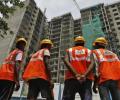
Modi govt must bring about reforms to kick-start big-ticket infra projects.

The Asian Development Bank has approved a US$ 1.5 billion (around Rs 11,185 crore) loan to India for COVID-19 vaccine procurement.

The senior IPS officer said that 45 percent of cyber financial frauds taking place in the country are originating from the South East Asia.

Barely two weeks after the Reserve Bank of India permitted 49 per cent foreign stake in stock exchanges

The decision was taken at the BRICS Summit in Durban which also launched a Business Council to encourage investment and trade in member countries and to expand business cooperation.

With the reality of coalition politics staring the BJP in its face, this was inevitable, points out Ramesh Menon.

With passenger growth pegged at 14 to 15 per cent, airport infrastructure could be a make or break business for both new players and incumbents.
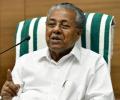
The Kerala chief minister's four years in office may well be remembered for the way he handled Cyclone Ockhi, two floods, Nipah, and now COVID-19, reports Shine Jacob.
Cash-strapped Air India will have to raise Rs 8,165 crore (Rs 81.65 billion) out of its own resources or borrowings to fund its fleet acquisition programme as the Union Budget focused primarily on aviation infrastructure development, giving a total budgetary support of Rs 190 crore (Rs 1.9 billion).

The National Company Law Appellate Tribunal has directed the new board of the debt-ridden IL&FS Group to distribute Rs 16,361 crore of cash and InvIT units available across the Group to its creditors on pro-rata basis. The interim distribution award of Rs 16,361 crore includes Rs 11,296 crore in cash and Rs 5,065 crore in InvIT units (Infrastructure Investment Trusts) and a majority of this is to be distributed to the creditors of three large group firms -- IL&FS, IFIN and ITNL. "The interim distribution shall be confined only to the entities as reflected in Annexure-6 except those excluded and for the amount of Rs 16,361 crores i.e Rs 11,296 crore of cash and Rs 5,065 crores of InvIT Units," said an order by a two-member NCLAT bench headed by Chairperson Justice Ashok Bhushan.

The number of deals announced in the month were the highest ever at 102 for any month, compared to 75 in the same period last year and 92 deals in March.

Finance Minister Nirmala Sitharaman on Tuesday said the upcoming Budget for 2021-22 will sustain the momentum of public spending on infrastructure and have a "vibrancy" to ensure the economic revival continues. She also said the pace of divestment, which has been hit by the COVID-19 pandemic, will pick up in the coming months. "We shall definitely sustain the momentum of public spending in infrastructure. Because that is the one way we assure that the multipliers will work and the economy's revival will be sustainable.... "I am conscious that the forthcoming Budget will have a vibrancy that is so required for the economy's revival, sustainable revival," she said at the Assocham Foundation Week. The Budget for the 2021-22 fiscal is expected to be tabled in Parliament on February 1.

'I found it unbelievable that L&T said 45,000 jobs were waiting to be filled because of unavailability of suitable skillsets.' 'So, when the Opposition sweepingly says there are no jobs, I'm sorry... I'm not saying it's raining jobs, but there are jobs. The (skill) gap has to be bridged.'

Prime Minister Narendra Modi Wednesday said the International Monetary Fund (IMF) sees India as a "bright spot" in the global economy and as per the World Bank, India is in a better position to deal with the global headwinds than many other countries. This is because of India's strong "macroeconomic fundamentals", Modi said while virtually addressing the inaugural function of the 7th edition of Invest Madhya Pradesh-Global Investors Summit in Indore. In the past eight years, the government has increased the speed of reforms and removed many hurdles in the way of investments.

Growing at a robust rate due to economic reforms in key sectors like digitisation and infrastructure, India has emerged as a star performer and is projected to contribute more than 16 per cent of the global growth, the International Monetary Fund said on Monday. "What we have been observing for quite some time now is that India has been growing at a very robust rate. "It's one of the star performers when it comes to real growth when you look at peer countries.
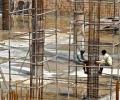
Hike in planned public-sector capital expenditure will be credit-positive for infra cos

Moody's has a 'positive' outlook on its 'Baa3' rating on India.

Banks are in need of government support to manage the stressed assets
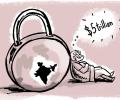
It would be a difficult task for the Indian economy to reach the $5-trillion mark a year before the International Monetary Fund (IMF) projection of 2026-27. Pankaj Chaudhary, minister of state for finance, said in the Rajya Sabha on Tuesday that the government is taking steps to make the country a $5-trillion economy at a date earlier than the IMF's projection. In that context, it would not be difficult to meet the projection in the third quarter of FY27.

Nothing is more promising than countries putting aside hubris and ideological differences to invest in our shared future, observes Durga Sreenivasan, a delegate at COP28.

Stocks of public sector undertakings (PSUs) have been on fire in the past year as investors cheered an improvement in key operating metrics and embraced counters of these state-owned enterprises, analysts suggest. The S&P BSE PSU Index has gained over 90 per cent in the past year, rising much higher than the S&P BSE Sensex, which has rose nearly 19 per cent during this period, according to ACE Equity data. The BSE PSU Index, reports show, has delivered a compound annual growth rate (CAGR) of 28 per cent (including dividends reinvestments) over five years and risen by almost 60 per cent in the past year.

Low oil prices also means effectively transfer of wealth from the producing nations to the consuming nations

When Vineet Mittal first got into solar power, sometime around 2009, and was planting solar panels in Gujarat, renewable energy looked like a sector ripe for startups. Renewables were clearly the future of energy, and the big boys - Mukesh Ambani's Reliance, Adani Group, and the Tatas - were focusing much more on coal and petroleum. Little did Mittal know that things were going to change drastically.

This Budget signals a shift from a hand-out to a hand-up economy.

Sounding a note of caution, former Reserve Bank Governor Raghuram Rajan has said that India is "dangerously close" to the Hindu rate of growth in view of subdued private sector investment, high interest rates and slowing global growth. Rajan said that sequential slowdown in the quarterly growth, as revealed by the latest estimate of national income released by the National Statistical Office (NSO) last month, was worrying. Hindu rate of growth is a term describing low Indian economic growth rates from the 1950s to the 1980s, which averaged around 4 per cent.

Among other proposals, she said NRI portfolio route would be merged with the FPI route for seamless investment in stock markets.

Mutual funds, as experts and custodians of another set of retail investors' savings, play a speculative game they are neither supposed to nor equipped to do, cautions Debashis Basu.

'They are also sitting on huge public sector assets without many returns.'
